Killer UX Design Chapter 4 - Insights Phase
post-research tasks:
Immediate tasks:
■ Return to the office and write on sticky notes of a given color the high-level themes I’ve observed
■ Write down direct quotes that capture the most important stories on a sticky note of another given color (say pink for user quotes).
Creating a Common Project Space which will help facilitate discussions.
Process of Affinity Mapping (KJ Method)
Reviewing Your Notes: transfer it to sticky-notes or any format that you can easily manipulate by moving it around and looking for patterns. Clustering and towering allows you to rethink the data, helping patterns to emerge and opportunities to be identified. The benefits of affinity mapping are:
■ group, review, and transform the findings as you continue analyzing the data
■ refine the information and remove the noise
■ home in on key themes, patterns of behavior, and emergent opportunities from the data
Insights into Opportunities
Behavior Design

3 core motivators. Each of these has two sides:
three paths to increasing ability:

Prompts tell people to "do it now!"
- Prompts can lead to a chain of desired behaviors
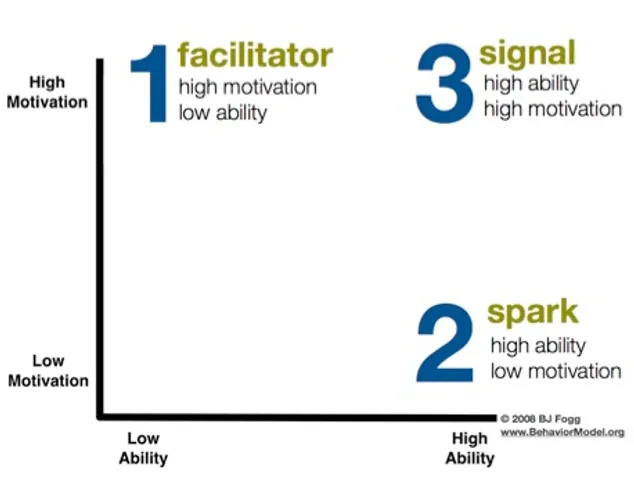
a Prompt can be external, like an alarm sounding. Other times, the Prompt can come from our daily routine. Three types of Prompts: Facilitator, Signal, and Spark.
An effective Prompt for a small behavior can lead people to perform harder behaviors. It’s a natural chain of events that an effective Prompt puts into motion.
The smart designer asks people to do simple things -- walk for 10 minutes, click here. Once achieved, the simple behavior then opens the door to harder behaviors: buy walking shoes, connect to more friends.
Immediate tasks:
■ Return to the office and write on sticky notes of a given color the high-level themes I’ve observed
■ Write down direct quotes that capture the most important stories on a sticky note of another given color (say pink for user quotes).
Creating a Common Project Space which will help facilitate discussions.
Process of Affinity Mapping (KJ Method)
Reviewing Your Notes: transfer it to sticky-notes or any format that you can easily manipulate by moving it around and looking for patterns. Clustering and towering allows you to rethink the data, helping patterns to emerge and opportunities to be identified. The benefits of affinity mapping are:
■ group, review, and transform the findings as you continue analyzing the data
■ refine the information and remove the noise
■ home in on key themes, patterns of behavior, and emergent opportunities from the data
Insights into Opportunities
- Verbalizing the findings forces you to explain it, so you are in effect making sense of it for yourself too.
- Sketch solutions when you are feeling inspired. Sketching acts as a vehicle towards deeper understanding.
- there are no bad ideas at this point. Try to generate as many ideas as you can, and this stage of the process is about exploration.
- encourage everyone to build on what’s presented rather than shooting anything down "extending this idea ...."
on the Lookout For
- when participants have created shortcuts or their own way of doing tasks.
- Consider their motivations and drivers;
- observe their habits and behavior,
- the spoken and the unspoken needs.
This tells you where they might be seeking a better or
more simplified way to perform a task, and this is where your design efforts can be
usefully focused.
Design Gap?
design gap happens as a result of flaws in the design process, leaving a range
of basic human needs unmet. Clients might be unable to express their needs; the
vision might be unclear; the designers might not listen to what’s said, or bias what
they hear to conform to their own assumptions. (There’s an interesting article by
Elliot Felix on the design gap in the context of architecture in The Journal of
Design Strategies, Vol. 4, No. 1, Spring 2010.)
A significant benefit of the UX process is that it narrows the likelihood of user needs
being inadequately met or client needs being misinterpreted in a design project.
Structure insights from your research to move into ideation - How can we ...?

Behavior Design
B.J. Fogg Behavior Model -discuss the power of technology in persuading
humans to do tasks they might not have ordinarily bothered to do.
B=MAP, where B is behavior, M
is motivation, A is ability, and P is a prompt.

The Fogg Behavior Model (FBM) outlines Core Motivators (Motivation), Simplicity Factors (Ability), and the types of Prompts. Motivation and Ability have a compensatory relationship to each other.
3 core motivators. Each of these has two sides:
■ sensation (pleasure and pain)
■ expectation (hope and fear)
■ belonging (acceptance and rejection)
■ expectation (hope and fear)
■ belonging (acceptance and rejection)
three paths to increasing ability:
- train people, giving them more skills, more ability to do the target behavior. (Don’t take this route unless you really must. most people resist learning new things. )
- give someone a tool or resource that makes the behavior easier to do, e.g. manuals.
- scale back the target behavior so it is easier to do.
In Behavior Design, By focusing on Simplicity of the target behavior you increase Ability.
Here’s a model that shows these five factors. Your weakest link determines what makes a behavior hard to do.
Prompts tell people to "do it now!"
- Prompts can lead to a chain of desired behaviors
a Prompt can be external, like an alarm sounding. Other times, the Prompt can come from our daily routine. Three types of Prompts: Facilitator, Signal, and Spark.
An effective Prompt for a small behavior can lead people to perform harder behaviors. It’s a natural chain of events that an effective Prompt puts into motion.
The smart designer asks people to do simple things -- walk for 10 minutes, click here. Once achieved, the simple behavior then opens the door to harder behaviors: buy walking shoes, connect to more friends.
The Opportune Moment (Kairos)
When designing, ask yourself: when is the kairos for your user? When are they
most motivated and most likely to act in the way you intend? You need to understand the impulse and design around it.
our users:
■ need to notice the prompt
■ should associate the prompt with the target behavior (for example, my morning
coffee at my desk)
■ are motivated when the prompt occurs and are able to act


Comments
Post a Comment